
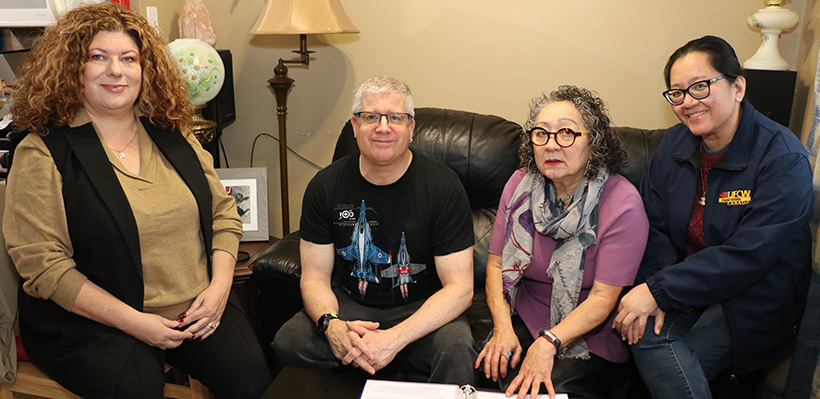
As a truck driver at Darling for 14 years, Mike Gallagher drove six days a week to farms north of Toronto, gathering meat waste products for recycling.
A routine Monday at work quickly turned into a life-changing nightmare for Mike, after he fell on uncleared snow and ice at a company client’s site.
“I was able to drag myself to the office so the customer could call an ambulance,” he said. “I tried to stand but I couldn’t. I never felt pain like that before.”
After he fell, Mike was rushed by ambulance to a local community hospital where he would be initially misdiagnosed with a sprain on his right knee and was discharged with a muscle relaxant. The faulty diagnosis would only be discovered a month later by another hospital.
Though Mike was in excruciating pain, the Workplace Safety and Insurance Board (WSIB) and the company pushed for Mike to return to work the next day on modified duties.
Mike went to his doctor, who wrote him a note to stay home for at least two weeks. Facing pressure to return to work, Mike went back after a few weeks.
The situation got worse a month later when his leg gave out, causing him to fall and injure his other leg.
“I was in a lot of pain,” he said. “I was in my bedroom, on the floor, with the front door locked. The paramedics had to break in to get me — I couldn’t move.”
Transported by ambulance to a different hospital, Mike underwent an ultrasound which revealed several tendon ruptures: three on his left knee, two on his right knee. As it turned out, the first hospital had got it completely wrong.
“My injury took a toll, emotionally, and physically,” he said. “You are constantly fearful of falling again.”
He said it’s been quite a journey. Mike would undergo surgery to the left knee. With the right knee, Mike was told by his surgeon that any surgery could make his mobility worse. Today, he is still in pain and using a cane to go up the stairs. “It has taken a toll — it’s life altering,” he said. “I can’t run, or jump. Getting into and out of bed is extremely difficult.”
The treatment from WSIB and the company has made things more difficult.
“They make the whole process difficult – they want you to give up,” he said. “They try to frustrate you, even with medical evidence. You can’t give up. You have to fight for yourself – the union makes the fight easier.”
When Mike was denied WSIB compensation, the union stepped in to help him with the appeal. With the help of the union, he won the WSIB appeals, allowing entitlement for the right knee injury, secondary entitlement for the left knee, and loss of earnings. His physiotherapy is also now covered by WSIB.
“I wouldn’t be in the position I’m in without the support of my union,” he said. “Their legal representation has helped immensely.”
He is grateful to have 1006A by his side.
“The union was crucial for me to win my appeals.”
Mike advises members to get in touch with the union, if they are injured at work.
“My advice to members is to contact your union representatives so they can understand your situation and make the appropriate recommendations,” Mike said.
He encouraged injured workers to keep the union informed by forwarding them all communication, particularly with the company and WSIB
“Your union will help you. All members should carry a collective agreement and actually read it.”